- Considering infinitely many discontinuities
- Considering functions which are discontinuous on an uncountable set
This post came about as I was looking at Abbot’s “Understanding Analysis”. I wanted to see what more I could learn and what follows from my first two analysis courses. I am mainly using this book as reference.
Considering infinitely many discontinuities
One of the problems set after having learnt the definition of the Reimann integral, is to show that if a function ![[a,b]](https://s0.wp.com/latex.php?latex=%5Ba%2Cb%5D&bg=ffffff&fg=000&s=0&c=20201002)
![f:[a,b] \rightarrow \mathbb{R}](https://s0.wp.com/latex.php?latex=f%3A%5Ba%2Cb%5D+%5Crightarrow+%5Cmathbb%7BR%7D&bg=ffffff&fg=000&s=0&c=20201002)


What about if

To begin with, the Thommae function below is an example of a function that has infinite discontinuities and is Reimann-integrable. In particular the set of discontinuities is countable, as it is discontinuous at every rational point, and continuous at every irrational point.
I’ll quickly show that it is discontinuous at every rational point. Consider

![(x_n) \subset [0,1]](https://s0.wp.com/latex.php?latex=%28x_n%29+%5Csubset+%5B0%2C1%5D&bg=ffffff&fg=000&s=0&c=20201002)


![[0,1]](https://s0.wp.com/latex.php?latex=%5B0%2C1%5D&bg=ffffff&fg=000&s=0&c=20201002)

So functions that have infinite discontinuities can be integrable.
Considering functions which are discontinuous on an uncountable set
What about functions that have uncountably many discontinuities? Let


Is it the case that all functions where the set of discontinuities is uncountable are not Reimann-integrable? Nope. I find that quite cool, as when one thinks “uncountable discontinuities”, that just feels like too many problem-points. How can there be an “area” associated with such a function?
When reading about this topic, I came across, for the first time, the Cantor set. I’m going to use it to construct a function that is discontinuous on an uncountable set of points and is also Reimann-integrable. After that example, we are going to see a criterion for Reimann-Integrability using the set of discontinuities of a function.
The Cantor Set
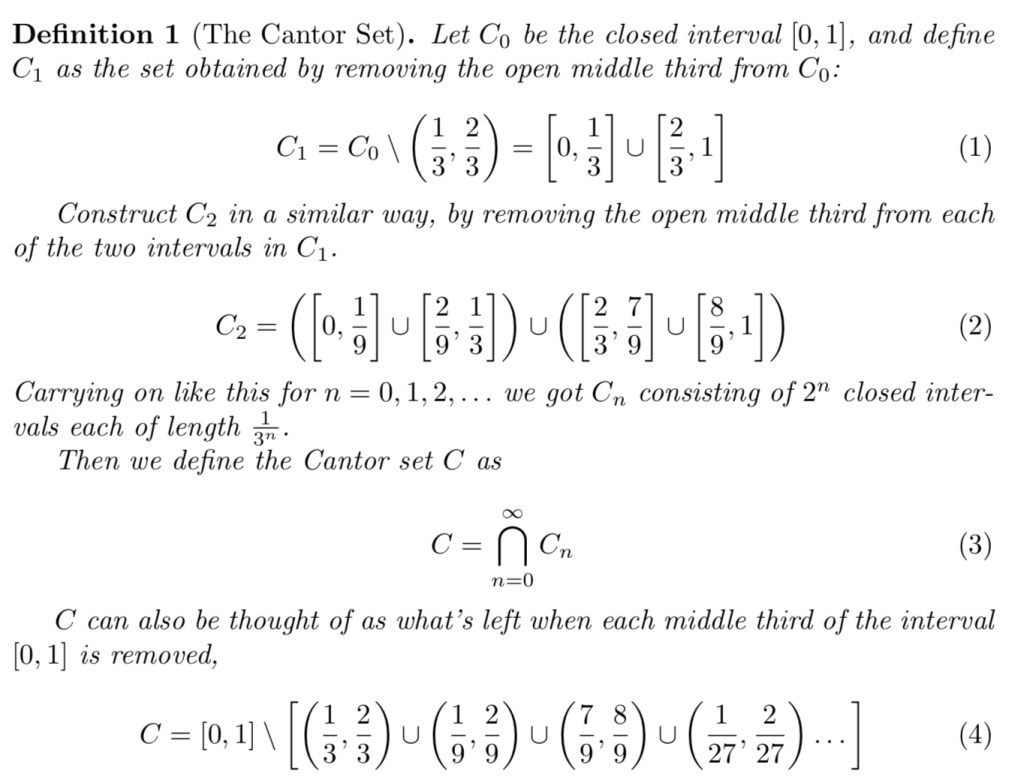
For a visualisation of the construction of

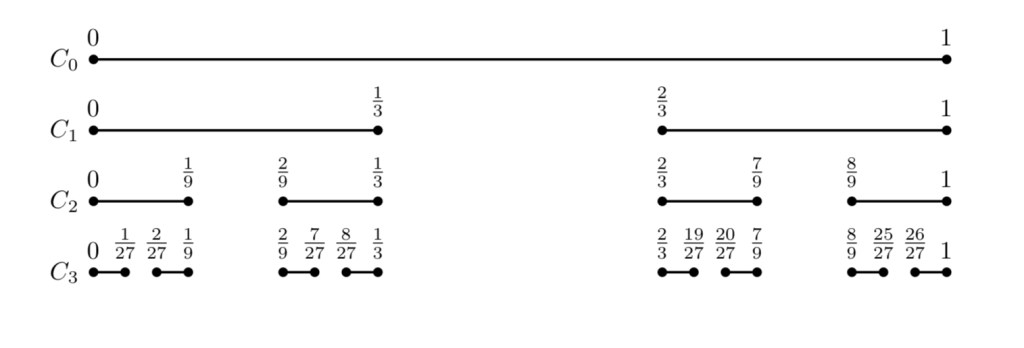
The Cantor set is uncountable, and has length zero. We can see the latter when we subtract the total of the closed intervals from the interval .

Cantor Indicator function and its integrability
Consider the Cantor indicator function on
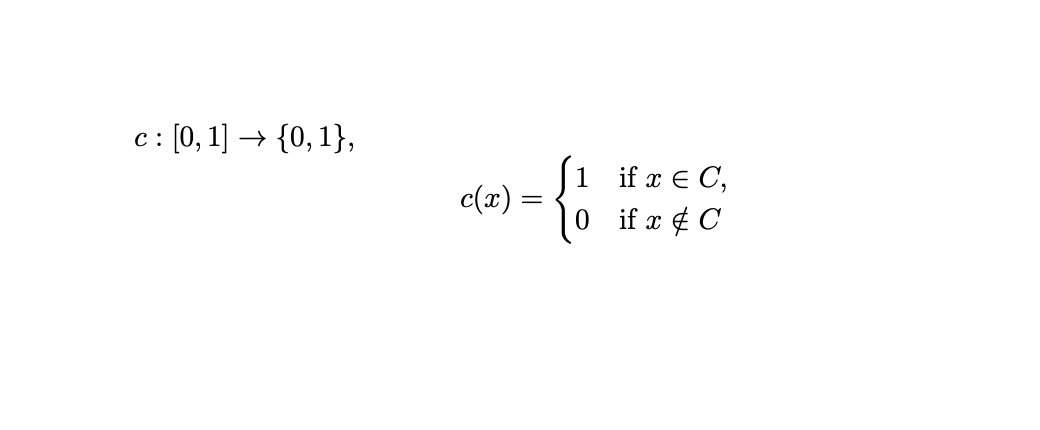
This function is discontinuous at every point


Is this function integrable on

 Proof pending
Leave a comment