
287 · case1950 · Western North Atlantic between Bermuda

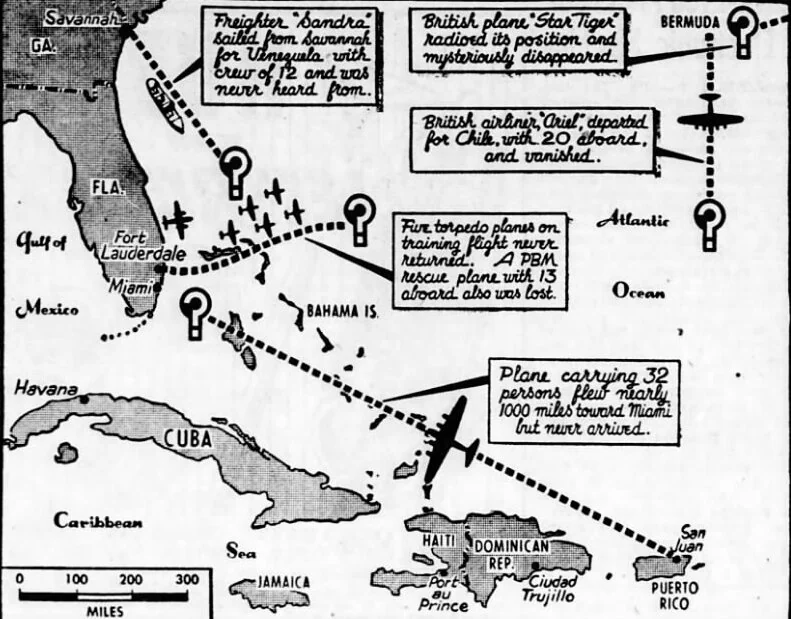
The Bermuda Triangle
The Bermuda Triangle: how a zone of disappearances was built, and what the record shows
The account
September 17, 1950 (first press suggestion); named 1964. Western North Atlantic between Bermuda, southern Florida and Puerto Rico.
The idea that ships and aircraft vanish unusually often in one stretch of the western Atlantic first appeared in an AP article by E.V.W. Jones on 17 September 1950. George X. Sand outlined a triangle in Fate in 1952, and Vincent Gaddis's Argosy article of February 1964 linked the losses into a pattern, suggesting 'an unknown type of atmospheric aberration' or 'a hole in the sky'. Charles Berlitz's best-selling The Bermuda Triangle (1974) listed causes including 'capture and kidnaping by flying or submarine UFOs' and Atlantis. Larry Kusche's The Bermuda Triangle Mystery: Solved (1975) called it 'a manufactured mystery'.
The record
NOAA says the U.S. Navy and Coast Guard 'contend that there are no supernatural explanations for disasters at sea', that the U.S. Board on Geographic Names does not recognise the name, and that storms, Gulf Stream weather and shallow reefs 'could explain many, if not most' of the losses. Coast Guard inquiries contradict specific Triangle accounts, such as the tanker V.A. Fogg, whose wreck it photographed and whose crew bodies it recovered. Wikipedia reports that Lloyd's of London, asked for a Channel 4 programme, found that unusual numbers of ships had not sunk there.
Still pending
The Jones 1950 and Sand 1952 articles were not opened, nor was Kusche's book. The Lloyd's finding rests on a Wikipedia summary; the Channel 4 programme and its date were not opened.
Cited sources
- NOAA National Ocean Service, What is the Bermuda Triangle?
- Wikipedia, 'Bermuda Triangle'
- Vincent H. Gaddis, The Deadly Bermuda Triangle, Argosy, February 1964 (text)
- Charles Berlitz, The Bermuda Triangle (text of 1984 edition)
- Wikipedia, The Bermuda Triangle (book)
- Charles Apple, When Flight 19 Disappeared, The Spokesman-Review, 4 December 2025