
282 · case1918 · Western Atlantic
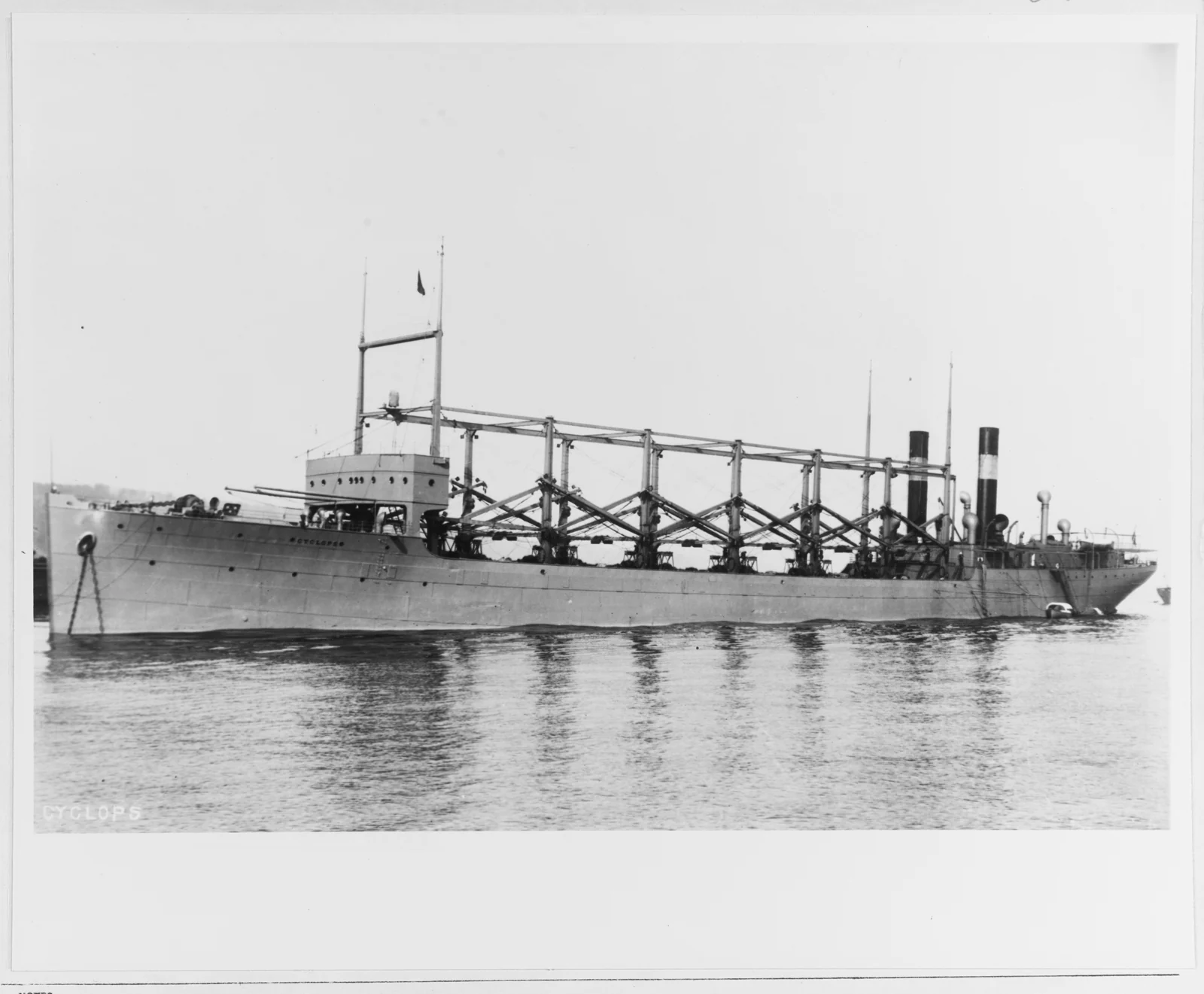
USS Cyclops vanishes
USS Cyclops: a Navy collier lost without trace, later claimed for the Bermuda Triangle
The account
March 1918 (left Barbados March 4, 1918). Western Atlantic, between Barbados and Baltimore.
The Navy collier Cyclops sailed from Rio de Janeiro on February 16, 1918, called at Barbados on March 3 and 4, and was never heard from again. Wikipedia gives 306 crew and passengers, among them Lieutenant Commander George W. Worley and US consul-general Alfred Gottschalk; other contemporary figures differ. She was carrying manganese ore and was thought to be overloaded, and Worley had reported a cracked cylinder in the starboard engine. Her loss later became one of the incidents listed in Bermuda Triangle literature, a framing that began with Vincent Gaddis's 1964 Argosy article.
The record
The Navy's Dictionary of American Naval Fighting Ships records the voyage and calls the loss 'one of the sea's unsolved mysteries'. Wikipedia quotes the Navy investigation as saying 'Many theories have been advanced, but none that satisfactorily accounts for her disappearance', via a secondary website that was not opened. No wreck has been found. US Navy photographs of the ship and a 1929 US Weather Bureau map of the March 1918 weather exist.
Still pending
The 1918 Navy court of inquiry papers have not been opened, and the exact number aboard varies between sources (306 per Wikipedia; a 1918 Boston Globe headline gave 293). No opened source names the first writer to place Cyclops in the Bermuda Triangle; Gaddis, Berlitz and Kusche's books were not opened.