
256 · case1960 · Earth orbit
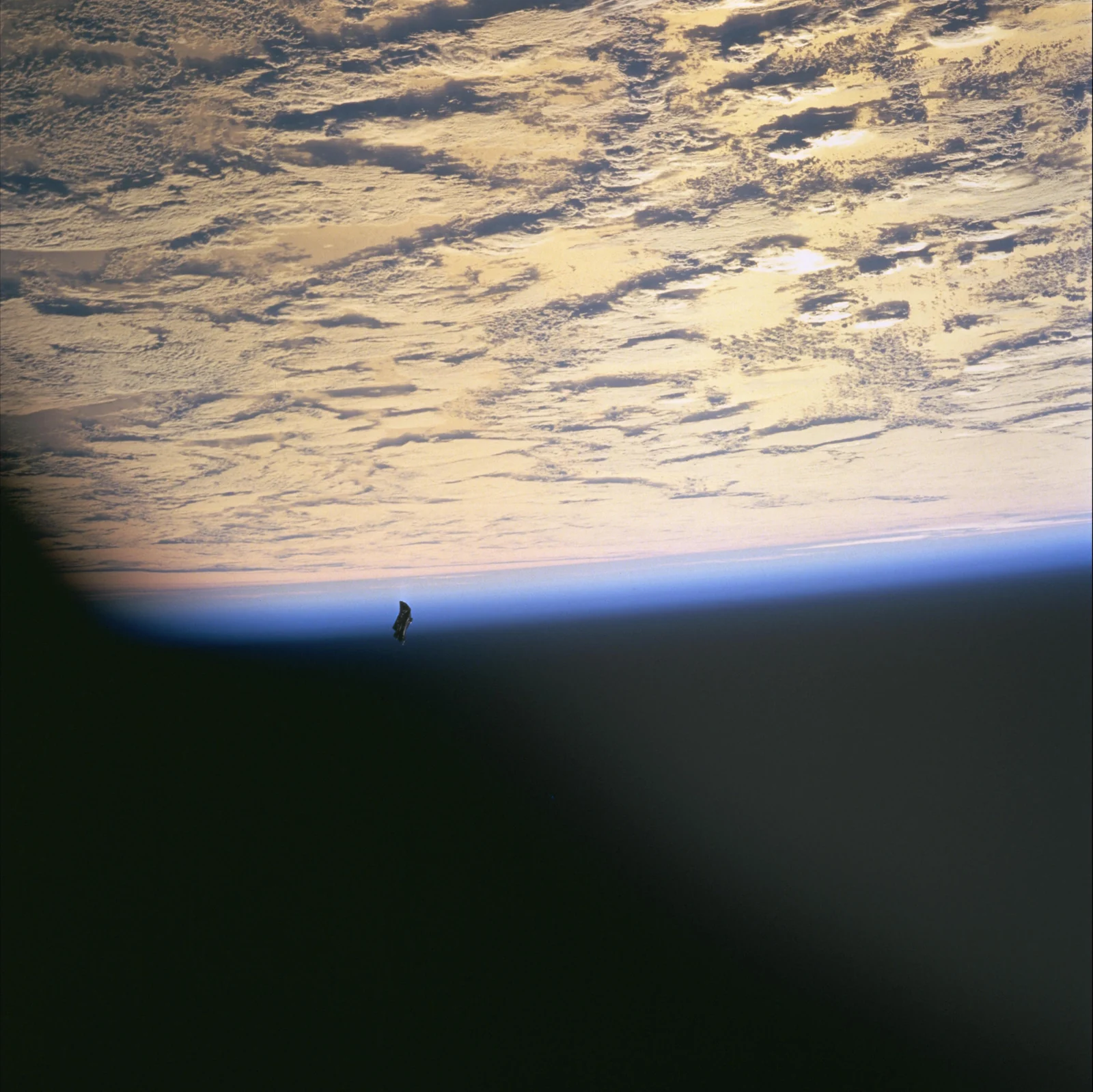
Black Knight satellite
The Black Knight satellite legend and the STS-88 space-debris photograph
The account
1954 to 1998 (legend assembled later from earlier events). Earth orbit; claims drawn from Norway, the United States and Scotland.
The Black Knight legend holds that an alien satellite has orbited Earth for thousands of years and that its existence is concealed. Proponents link Nikola Tesla's 1899 radio signals, long-delayed radio echoes first heard by Jørgen Hals in Oslo in 1928, Donald Keyhoe's 1954 newspaper claim that the US Air Force had detected two satellites before any nation could launch one, a dark object the US Navy tracked in 1960, a claimed sighting by Gordon Cooper on Mercury 9 in 1963, and Duncan Lunan's 1973 reading of the radio echoes as a probe from Epsilon Boötis. Since 1998 the story's usual image has been a photograph taken on Space Shuttle mission STS-88, which NASA catalogues as space debris.
The record
NASA's Earth observation catalogue holds frame STS088-724-66, taken on 11 December 1998 with a 250 mm Hasselblad, tagged 'SPACE DEBRIS'. Time reported in 1960 that the dark object was the remains of a Discoverer 8 satellite, which Air Force Secretary Dudley Sharp identified as a probable casing (per Skeptoid). Lunan's retraction, Cooper's own denial and NASA transcripts are reported in Skeptoid #365 and Wikipedia.
Still pending
James Oberg's STS-88 analysis (jamesoberg.com) could not be reached, nor could Keyhoe's 1954 press coverage or the 1960 Time articles be opened directly. The point at which the name 'Black Knight' was first attached to these events is not established in the sources opened.